Pull three different housing reports on Stamford this summer and you'll get three different numbers. One index puts the typical home's value at roughly $594,000 as of May 2026. A tally of actual closed sales over the three months ending that same May puts the median at $712,000. A third, once you filter for single-family sales only, puts the figure at roughly $975,000 as of mid-2026, nearly $400,000 higher than the first. None of these figures is wrong. They're measuring different things and reporting the result under the same label.
If you're comparing Stamford against Greenwich, Darien, or another Fairfield County town before deciding where to focus a search, that spread matters. A number that swings by close to $400,000 depending on which slice of the market someone measured isn't a rounding error. It's a sign that "Stamford" isn't one housing market. It's at least two, stitched together under a single city name, and the figure everyone repeats is really the average of two very different conversations.
What the Median Is Actually Blending
Stamford's housing stock splits cleanly along a line that citywide statistics tend to erase: property type, and proximity to the waterfront core.
Submarket | Typical product | Recent median | Window |
|---|---|---|---|
Downtown Stamford | Condo, 1BR | ~$330,000 | current listings |
Downtown Stamford | Condo, 2BR | ~$427,500 | current listings |
Glenbrook | Condo, 1BR | ~$243,000 | current listings |
North Stamford | Single-family | ~$1.3M | 3 months ending May 2026, up ~13.8% year over year |
Shippan | Single-family | ~$1.67M | current listings |
Citywide, all types (value index) | Blended | ~$594,000 | as of May 2026 |
Citywide, all types (sales median) | Blended | $712,000 | 3 months ending May 2026 |
Citywide, single-family only | Blended | ~$975,000 | mid-2026 |
Blend a city full of $243,000 to $430,000 condos with a city full of $1.3 million to $1.7 million houses and you get something close to the two citywide figures above: a value index around $594,000 and a sales median around $712,000, neither of which describes either market accurately on its own. Filter for single-family sales only and the number jumps to roughly $975,000, still below what North Stamford or Shippan alone would suggest, because it folds in more moderately priced single-family stock from neighborhoods like Springdale.
If you've been shopping Stamford by the median you saw on a national aggregator, you've been benchmarking against a hypothetical home you were probably never going to buy in the first place.
Why the Two Markets Diverge This Much
The split isn't random. One possible factor is where Stamford's largest employers are located.
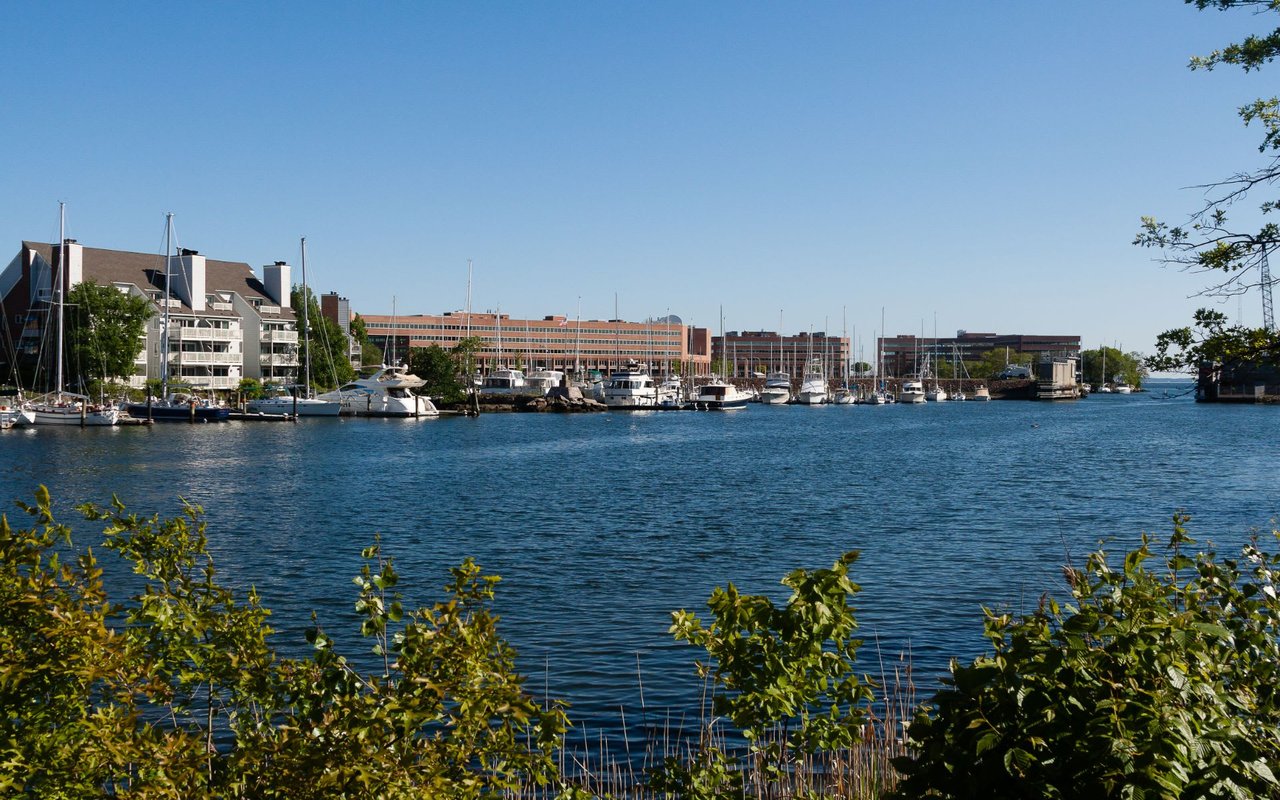
Charter Communications relocated its headquarters from St. Louis to Stamford, and in June 2022 opened a two-building, roughly 900,000-square-foot campus at 400 Washington Blvd inside Harbor Point, built to house around 1,700 employees at the time, with room for continued growth. Synchrony and NBC Sports also keep their headquarters in the city. That concentration of corporate jobs is within walking distance of the Stamford Transportation Center and may help explain demand for nearby condos and rentals; some workers may value a short commute.
Harbor Point is a mixed-use district on a former industrial brownfield, once dominated by the Yale & Towne Lock Works. Building and Land Technology redeveloped it with plans for roughly 4,000 residential units, a boardwalk, and a run of new restaurants and retail. That condo supply is elastic. When demand rises, more units get built.
North Stamford and Shippan sit on the opposite supply curve. Both are largely built out, with fixed lot lines and zoning that limits density, so when more buyers want a house with a yard, they're competing for a supply that can't expand the way Harbor Point's condo stock can.
That's the mechanical reason North Stamford's single-family median climbed roughly 13.8 percent year over year over the three months ending May 2026, while the citywide sales median for that same window rose only about 0.3 percent. Two different products, responding to the same regional demand with two different supply responses.
For investors comparing yield rather than list price, that split cuts even deeper. A condo purchase downtown or in Harbor Point, in the $330,000 to $430,000 range, is close to major employers including Charter, Synchrony, and NBC Sports. A North Stamford or Shippan single-family purchase serves an owner-occupier market where rental comparables are thinner and appreciation, not monthly yield, is the return driver. Treating both as "Stamford real estate" in the same spreadsheet is where a lot of underwriting goes wrong.
The Property Tax Detail That Changes the Comparison
There's a second layer that rarely makes it into a median-price conversation, and it matters the moment you start comparing a condo purchase to a single-family purchase on paper.
Stamford's mill rate for fiscal year 2026 is 23.27 mills, set citywide by the Board of Finance. Connecticut assesses real estate, so the mill rate applies to a smaller base than what a buyer actually paid. On paper that sounds like it treats every property the same. In dollar terms it doesn't.
A $400,000 condo and a $1.3 million single-family home are taxed at the identical mill rate, but the condo's assessed value, and therefore its tax bill, is a fraction of the house's. Owning in North Stamford or Shippan means carrying a proportionally larger annual bill even though the rate itself never changes. Layer in the fact that Stamford is divided into four geographic taxing districts with somewhat different levies depending on which municipal services reach a given property, and the swing between neighborhoods widens further. The city's own assessment office confirms the most recent citywide revaluation took effect October 1, 2022, which means the assessed values behind today's tax bills are still anchored to that reassessment rather than to this year's sale prices. You can see the full mill rate history for Connecticut municipalities through the state's open data portal.
None of this shows up in a median price headline. It shows up on the first tax bill after closing.
How to Read a Stamford Price Stat Before You Act On It
Before treating any Stamford number as comparable to a listing you're actually considering, run it through three questions.
- Is this a single-family figure or a blended "all property types" figure? The gap between the two is currently worth several hundred thousand dollars.
- What submarket does the sample come from? A North Stamford or Shippan median tells you almost nothing about what a Downtown or Glenbrook condo will cost, and the reverse is equally true.
- What taxing district is the property in, and when was it last reassessed? Two homes at the same purchase price can carry meaningfully different annual tax bills depending on where in the city they sit.
Stamford's overall market stayed competitive through the first half of 2026, with homes across all property types selling in around 31 days and drawing an average of roughly four offers over the three months ending in May, according to recent multiple listing service data. That competitiveness is real. What it doesn't tell you is which Stamford you're actually competing for: the elastic condo market near the water, or the fixed-supply single-family market inland.
FAQ
Why did North Stamford prices rise so much faster than the citywide median? North Stamford is a fixed-supply single-family market with little room for new construction, so when demand increases, price is the variable that has to move. Downtown and Harbor Point can add condo units to absorb demand, which keeps that side of the blended median comparatively stable.
Do condo owners in Stamford really pay less property tax than single-family owners? In absolute dollar terms, generally yes. Connecticut taxes the assessed value, and condos typically carry lower market values than single-family homes in the same city. The rate is the same. The base it applies to is not.
Is the citywide median useful for anything? It's useful for tracking broad direction, whether the market firmed or softened overall, but it shouldn't be used to judge whether a specific listing is priced fairly. For that, you need the submarket median for that property type and that location.
Comparing Stamford to Greenwich, Darien, or the rest of Fairfield County starts with knowing which Stamford you're actually pricing. If you want a submarket-level read tailored to the type of home you're after, condo or single-family, waterfront or inland, The Rosato Team can walk you through the numbers that apply to your specific search rather than the citywide average. Get Your Home Valuation and we'll start with the data that matches your property.
This article is general information, not legal, tax or financial advice. Consult a qualified professional about your situation.