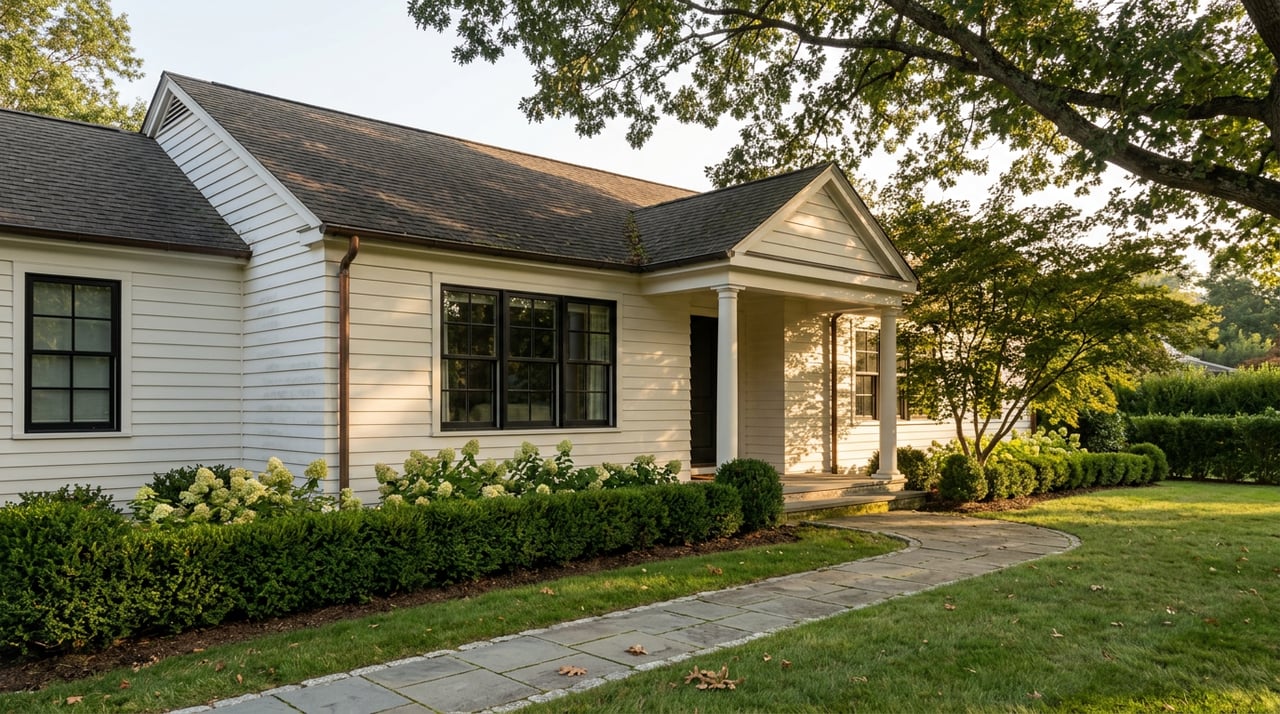
A buyer walks into New Canaan with a simple assumption: more land costs more money. So when a four-acre lot near Route 123 is priced close to a two-acre lot ten minutes closer to the train, the four-acre lot looks like the deal. Take it, and the math doesn't work out the way the acreage suggests it should.
That assumption used to be reliable in this town. It stopped being reliable somewhere around 2023, and most people shopping New Canaan right now haven't caught up to the change.
How New Canaan's Winning Zone Keeps Changing
New Canaan's zoning map splits the town into acreage tiers: a four-acre minimum in the north, two-acre and one-acre bands moving toward the center, and an under-one-acre core within walking distance of Elm and Main. For most of the last two decades, whichever tier was "winning" on price told you something real about what buyers wanted. The trouble is that the answer keeps changing, and each answer had a different cause.
Before 2004, the four-acre zone north of town was the assumed prize. Then the 2004 sale of a home on South Avenue, followed quickly by another on Brooks Road, kicked off a wave of in-town teardowns and rebuilds. For the next decade and a half, buyers who wanted new construction with a walk to the village paid a premium for smaller in-town lots, and the four-acre zone north of Route 123 became the town's most overlooked value, not its most coveted one.
Covid reversed that overnight. With commute distance suddenly irrelevant and space suddenly everything, the four-acre zone flipped from liability to asset. A ten-year sales analysis published by the New Canaan Sentinel found that the four-acre tier, which represents only about 6 to 13 percent of total sales, went from the least valuable zone in town to the most valuable almost as soon as remote work took hold.
That peak has already passed. According to the same analysis, the one- and two-acre zones have shown the most consistent price growth since the four-acre surge cooled, overtaking it as the segment buyers are actually competing for today. The pattern isn't about which zone has the most land anymore. It's about which zone offers enough land without the upkeep that comes with all of it.
| Era | Zone that led on price | What was driving it |
|---|---|---|
| Before 2004 | Four-acre, north of town | Land and privacy assumed to be worth any commute |
| 2004 to 2020 | In-town, under one acre | Teardown-rebuild wave, walkability to Elm and Main |
| 2020 to roughly 2022 | Four-acre, north of town | Space took priority over commute during the pandemic |
| Now | One- and two-acre | Buyers want scale without the maintenance load |
Why the Two-Acre Lot Beats the Four Right Now
The mechanism behind the current shift is not mysterious once you look at who is buying and what they're actually maintaining. A four-acre property in New Canaan doesn't come with four acres of lawn crew included. Someone pays for that landscaping every week, and the cost has climbed enough that it now shows up in how buyers rank properties, not just in their closing costs.
The Sentinel's columnist put it plainly by pointing to his own family history: his grandfather, who owned four acres on North Wilton Road in the 1970s, mowed that lawn himself. Almost nobody buying at that price point today does. Once landscaping becomes a recurring line item instead of a Saturday chore, the appeal of maximum acreage competes directly with the appeal of acreage you can actually use without hiring a crew to manage it.
That is the real story behind the one- and two-acre zones pulling ahead. Buyers aren't choosing less land because they can't afford more. They're choosing a lot that reads as private and substantial without becoming a second job. The four-acre zone hasn't stopped selling. The remaining demand comes from a genuine, if smaller, pool of buyers who still prioritize scale over convenience, particularly toward the far edges of town. A price opinion on Barnegat Road, about as far north as New Canaan goes, still came in above 3.5 million dollars according to the same analysis. The point is that this is no longer the default winning bet it was during the pandemic years.
The School District Premium That Has Nothing to Do With the School District
There's a second pattern in the same data that trips up buyers comparing New Canaan's three elementary districts. West has recently out-priced South and East, with average sale prices climbing toward 2.58 million dollars compared to roughly 2 million in East, even though commute distance and downtown proximity, which historically favored South and East, matter less to buyers than they used to.
The instinct is to assume West is simply the more desirable district. The data suggests something more specific: the typical home that sold in West was built in 1973, five years newer than the typical East sale from 1968 and three years newer than the typical South sale from 1970. West isn't winning because of the school boundary. It's winning because more of its housing stock has cycled through a teardown or major renovation, and buyers are paying for the newer construction they find there, not for the district line itself.
That distinction matters if you're comparing two listings in different districts at similar price points. The premium you're paying may have nothing to do with which elementary school your child would attend and everything to do with when the house was actually built.
What Your Money Buys Depends on Which Corridor You're Standing In
New Canaan's geography still sorts buyers by what they're optimizing for, even as the acreage math shifts underneath them. The walk-to-downtown corridor radiating from Elm and Main, stretching out through South Avenue and Farm Road, commands a consistent premium tied directly to Metro-North access. Buyers who want to walk to the New Canaan branch and skip the second car pay for that convenience, and inventory in that stretch stays tight.
Move toward Carter Street, Weed Street, and the streets around Alan Lane on the Upper West Side, and you're in estate-scale territory, where lot depth and price both push well past 4 million dollars. This is the zone still rewarding the buyer who wants land as a feature, not a compromise.
Silvermine, which New Canaan shares with Wilton, serves a different buyer entirely: someone prioritizing preserved forest and a slower pace over walkability, often at a gentler price than the Upper West Side for a similar sense of privacy. And the corridor along Oenoke Ridge toward the Darien line gives buyers a middle path, more land than the in-town core without committing to the full four-acre zone and its maintenance overhead.
None of these micro-markets move in lockstep. A buyer comparing a listing in the walk-to-downtown corridor against one on Weed Street isn't really comparing two houses. They're comparing two different reasons people choose this town in the first place, and the acreage tier attached to each listing tells you which reason you're paying for.
Where the Town-Wide Number Fits In
New Canaan's median sale price sat at 2,795,000 dollars as of September 2026, based on SmartMLS data, with inventory running close to one month of supply and homes closing at roughly 102 percent of list price. That single figure is real, but it's an average pulled across four acreage zones and three school districts that are behaving differently from each other in the ways described above. A buyer using the town-wide median to budget for a specific zone or district is very likely to be wrong about what a competitive offer actually requires, in either direction.
If you're comparing New Canaan against a neighboring town on price alone, or comparing two New Canaan listings on acreage alone, the median is a starting point, not an answer.
Frequently Asked Questions
Is the four-acre zone still a good buy in New Canaan? It can be, particularly at the far northern edge of town, but it is no longer the default premium tier it was during the pandemic years. Sales there have continued at a smaller volume, driven by buyers who specifically want maximum scale rather than the buyer pool as a whole.
Does a newer school district mean a better school district? Not necessarily. The price gap between West, South, and East tracks more closely with the age of the housing stock that has recently sold in each district than with any difference in school quality or boundary. A buyer choosing between districts should separate the housing question from the schools question rather than assuming one price implies the other.
If you're weighing acreage against location in New Canaan, or trying to figure out what a specific zone or corridor is actually worth right now, The Rosato Team can walk you through the current data street by street. Get Your Home Valuation to see where your property sits in this market today.
This article is general information, not legal, tax or financial advice. Consult a qualified professional about your situation.